A buzzard has struck again, dragging an osprey chick from the same nest where one of the rare birds of prey was killed by a buzzard last year - and the attack was again caught on camera.
"This is the second year that Buzzards have attacked the chicks, last year one was killed by the buzzards, this year both chicks (almost fully grown) were removed from the nest by Buzzards," writes Jake Webster from the Lochter Activity Centre in Aberdeenshire, who caught the footage on a fixed CCTV camera. View the video here:
I was invited by South Yorkshire Police to take part in Operation Dunlin, a major offensive against wildlife crime across the South Yorkshire area, overnight on Thursday 3rd-Friday 4th March.
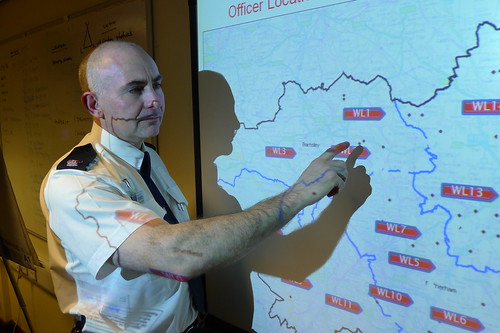
It was a fascinating insight into the nature of wildlife crime (at least in that area), the way police tackle it, and the problems they face. I'll write up the night's events separately, but here's a short audio interview with Superintendent David Hartley (pictured above), wildlife lead for South Yorkshire Police, and Silver Commander for the operation.
He talks about the nature of wildlife crime in his area (mostly lamping with dogs on farmland), his relationship with local gamekeepers (valuable eyes and ears, and an important part of the rural community), the incidence of bird of prey persecution (virtually nil, except one case where a farmer, not a gamekeeper, was convicted of placing a poisoned carcase), and the use of the Hunting Act (irrelevant as regards foxhunting, but can be a useful tool against poachers lamping with dogs).
The British Association for Shooting and Conservation (BASC), has commended the Scottish Parliament for passing sensible and functional legislation aimed at protecting Scotland’s wildlife.
Under the Wildlife and Natural Environment (Scotland) Bill outdated game licences have been abolished, archaic poaching laws have been reformed and the practice of catching up game birds for breeding stock has been legally recognised.
Vicarious liability, which will make the perpetrators of persistent raptor persecution accountable for the actions of their employees, is a measured and targeted approach to addressing wildlife crime.
Snaring remains a legal practice in spite of an attempt to ban it. However further regulations have been brought in to ensure best practice. These include the use of tags and record keeping, as well as training and accreditation.
Several amendments which would have restricted shooting by introducing the power to remove shooting rights have been defeated. A proposal to transfer some police powers to other agencies, such as the Scottish SPCA, was withdrawn.
BASC Scotland’s Nicolle Upton said: “BASC Scotland has been working tirelessly to ensure that this legislation would benefit shooting and gamekeeping. Unreasonable proposals to restrict deer stalking were dealt with at the consultation stage and the Bill as introduced was welcomed by shooters. The Bill has been a useful vehicle which has given MSPs the opportunity to see land management activities such as snaring in practice and to be briefed in depth on how the countryside actually works. As a result we have achieved something both sensible and workable."
It seems there are some people in the birding community who cannot abide the idea of birders and shooters working together - and are prepared to break the law to torpedo progress.
Chrissie Harper, who runs an owl rescue and gratefully accepted donations from shooters to buy some much needed hospital boxes (story here and here), has now received threats and hate mail.
An anonymous letter sent to Chrissie says that "shooters are walking tall because of you", and on the back the threatening message "the world is a dangerous place".
Let's hope the raptor community are as quick to condemn this vile behaviour as they are to condemn alleged cases of raptor persecution.
This will come as a surprise to some people - but shooters rallied when Chrissie Harper put out a plea for help for her bird of prey rescue centre in Oxfordshire. Chrissie, who runs Chrissie's Owls and Stonesfield Owl Rescue, mentioned on Facebook that she was desperate for funds to buy new hospital boxes. The boxes were needed to cope with a massive increase in the number of owls and birds of prey needing treatment and rehabilitation, due partly to recent harsh winter weather, and partly to what Chrissie calls the 'Harry Potter effect'.
Shooters among Chrissie's circle of Facebook friends took up the cause, reposting the appeal and making their own donations - raising a total of £300. The amount was matched by an animal rescue centre near to Chrissie in Oxfordshire, enabling her to buy six boxes.
Here's Chrissie's heartfelt letter of thanks to me and the other shooters involved:
Chrissie's Owls and Stonesfield Owl Rescue was set up nine years ago by myself and my husband Tom, although I have worked with owls and birds of prey for twenty years, we run it together with the help of a few dedicated volunteers who help out when they can.
We have in our care forty four owls and birds of prey at the moment, these being mainly birds we have rescued from bad homes or ones which have been bought as pets, the Harry Potter effect, and then become unwanted. Last year we also took in or collected fifty wild owls and birds of prey that needed care until they could be returned into the wild, sadly a lot of these birds were very badly injured, mainly being struck by vehicles or because of the extreme weather conditions starving to death and although we try to save everything this is impossible and also heartbreaking when we lose one.
Last year was our busiest year ever and stretched us to the limit and we struggled to find room for some of the birds that needed our help, just before Christmas I was called out six times in as many days, we never refuse to help and provide a twenty four hour rescue service, we also have the complete support of our veterinary practice which we are very grateful for.
We have always raised our own money to fund our rescue, this is achieved by going to Country Shows and other outdoor events and I also give talks all over the country to groups and organisations, we also do a lot of school visits which we feel are very important as children are the future of our wildlife.
I have been totally overwhelmed by the help and support I received from people who I had never met but were my friends on Facebook when I mentioned our predicament and desperate need of Hospital Boxes to keep the large amount of rescued birds we had in last year and struggled to find room for, the response was amazing, I am very proud and had never asked for any help before but sadly felt that if we didn't get help we would not be able to do what we love and are committed to in the proper way.
The help I have received has made me many friends, many from an unexpected quarter, the shooting fraternity, I have to be honest and say that some of these people have had a few home truths from me in the past and to get their support and learn that they to have a genuine love for the owls and birds of prey that I dedicate my life to came as a big surprise to me. I have been very biased toward hunting, and I am afraid there is not much change in that direction, and shooting but this has shown me that we should not judge everyone by the few bad apples that spoil the barrel so to speak and we must all try and work together finding a solution to the problems facing our countryside today, it is time to talk not fight.
We run our own conservation scheme, all be it a small one and donate five owl and kestrel nest boxes every year locally to try and put something back for the pleasure we receive from working with these birds and hope to continue for a few more years, especially trying to help our beloved Barn Owl and the Kestrel which are in such decline.
The support I have had has shown me that we can work together and I would like to thank each and every one of you who gave so generously from the bottom of my heart, I have learnt a lot from you all and if I can change my attitude and work with you then others should be prepared to do the same, I will never agree to everything that happens but if this helps build bridges between people who shoot responsibly and people like me who donate our lives to the things we love and believe in then I will be happy.
I'm getting a number of supportive emails from shooters about my stance on harriers and raptor persecution generally. Interestingly, they all say "this is not for publication but..."
There are clearly a lot of shooters who, like me, find raptor persecution totally unacceptable - but are nervous of standing up and being counted. I can understand that. There's a sense you might be perceived as letting the side down, by appearing to side with the antis.
I think that's a mistake. I think shooters should proudly stand up and say that they're against raptor persecution, that they won't tolerate it on any shoot they're involved in, and that they'll do everything they can to bring criminals to justice.
Like me, they'll be suprised to discover just how much support they've got.
Here's a (redacted) example of the sort of messages I've been getting:
Hi James,
I've just read your item concerning hen harriers and shooting on your blog and would just like to say that I agree with everything you say. I've been interested in all aspects of shooting since my early teens (I've forgotten how long ago that is), but also have a keen interest in birds of prey...
...it's good to see this issue being addressed in a national shooting publication. I'm with you - raptor persecution is unacceptable and I feel that if it is not addressed by the shooting community, it will be the issue that is used by those opposing shooting to bring us down.
Things may look quiet on the surface, but underwater I have been paddling furiously. Which is a roundabout way of saying that I have been in contact with a wide variety of people who have an interest in raptors in general, and hen harriers and grouse moors in particular.
Treading carefully too, I might add - the subject arouses strong feelings. If you were to place some of the people I've been talking to in the same room... well, sparks would fly, maybe fists too. What has struck me, though, is that everyone has come across as impassioned and genuine, whatever their take on the subject.
I am not going to comment on how widespread the problem may or may not be - that's where most discussions run in to a brick wall. But talking to people on all sides of this debate, I am now convinced that some keepers firmly believe that they wouldn't be doing their job properly if they allowed harriers to set up home on their patch.
Equally, there are many in shooting (of whom I'm one) who believe that killing birds of prey is totally unacceptable, whatever the circumstances. If it means a grouse moor is financially unviable, tough. For me, shooting was never about money anyway.
When these two types of shooter collide, things get unpleasant. Imagine a situation where a young keeper with a 'modern' outlook finds himself working under an 'old school' head keeper, and gradually becomes aware that killing raptors is considered part of the job.
He wrestles with his conscience, perhaps for months. His career, his family's wellbeing, maybe even his own safety, depend on him keeping schtum, betraying everything he believes in. Perhaps that goes on, and he just learns to live with hating himself. Many of us have been in jobs like that. Or perhaps, brave soul, he decides to turn whistleblower.
First problem, where to turn? His employer? No chance. The RSPB? You must be kidding. The shooting organisations? They say they're against illegal killing, but when the chips are down can they really provide the care and, yes, protection, that our whistleblower is going to need? The police? That's probably where he turns - and that's when his personal hell escalates to a whole new level.
If we're ever going to tackle this problem head-on, this is the guy we need to support 100%. At present, it would take a very brave man indeed to dob in a rogue keeper. The RSPB's 'Bad Apples' campaign was aimed at such people, but it offered them no incentive, no protection. We need to do more. Who does, and how? Well, I don't have the answer, but my instinct is to look towards the keepers' organisations, who at least have some experience of supporting keepers in difficult situations, and of all those groups are most likely to be trusted by our man on the horns of a dilemma.
Whilst talking to various people involved in this debate, it struck me how in many ways it's similar to issues like the impact of tuna fishing on dolphins. Is there scope for a 'Raptor Friendly' scheme for shoots, just as you might see a 'Dolphin Friendly' logo on your tin of supermarket tuna?
The idea certainly has a superficial appeal - it could get shooting estates and the raptor lobby talking positively, which must be a good thing. But who would draw up the criteria? And who would administer the scheme? Would shoots really go along with something run by the RSPB? Or would we need another body to run it, one that's not perceived as so anti-shooting - even though that would weaken the value of the scheme?
Again, I don't know the answers - but I think the questions are worth asking, and I'd be very interested to hear views from all sides. Shout if you must, but I listen better when people talk nicely!
"We are only going to move on if there is broad agreement about illegal killing and impact," he says. "There are various possible solutions to the problem, but we are only going to get there through dialogue and especially dialogue between the moderates on both sides, whilst isolating the extreme views." For the record, he states that "there is pretty compelling evidence from a variety of sources that illegal killing is going on and limiting harrier numbers on managed grouse moors".
Steve also warned me against writing off the raptor lobby as extremists, pointing out that they are as diverse as the shooting lobby, with a wide spread of views. And he pointed me in the direction of some of his published work on this subject - for instance the positive and forward-looking Hen harriers and red grouse: moving towards consensus? published in the Journal of Applied Ecology in 2009. He also pointed me to the Environment Council's Hen Harrier Dialogue.
Steve has given me plenty to think about, and plenty of homework to do - but I find it immensely encouraging that this sort of work is already going on towards a solution.
Over the next few days I hope to talk to several people at the sharp end, as it were, and discover what the conflict looks like from their perspective. Watch this space...
Hen harriers are in the news again. This may or may not have something to do with the fact that the WANE (Wildlife And Natural Environment) Bill is currently going through the Scottish Parliament, and various groups have identified it as their best chance of attacking sporting estates in general, and shooting in particular.
They're jumping at the opportunity to have the law rewritten in their favour - perhaps winning the 'vicarious liability' that they claim would solve everything (it wouldn't, but that's another story)
The more strident anti shooting/pro raptor voices are growing shriller, and we are seeing the carefully managed 'release' of 'suppressed' information which, it's claimed, provides scientific proof, no less, of widespread 'persecution' by gamekeepers threatening the very existence of an iconic bird of prey.
'Silence over hen harrier carnage' shrieks the Raptor Persecution Scotland blog, for instance. They point to 'damning evidence' presented in the leaked Hen Harrier Conservation Framework [word doc] which they claim demonstrates 'the indisputable link between hen harrier persecution and heather moorland that’s managed for red grouse shooting'.
Actually, it isn't, and it doesn't. The report brings no new evidence to light. Much of it is a round-up of previously published work - and if you look back at that previously published work, it's clear that evidence is actually very thin on the ground.
What the report mostly does, is sucks a finger, sticks it in the air, and says: 'Hmm, I bet there should be 2500 pairs of harriers round here, and actually we can only see 749. I blame the bastard gamekeepers.' That's not science, no matter how you dress it up - and dress it up the authors have, in a report that runs to 69 pages which have cost the taxpayer... well, perhaps someone would like to tell me?
In fact, the more I look at the published reports, papers, reviews and what-have-you, it becomes clear that they tend to emanate from a small group of indivduals with a vested interest in talking up the problem, some of whom have seemingly made a career out of taking public money to write yet more reports regurgitating their own and their mates' work.
Be that as it may, it doesn't prove anything one way or the other. No doubt people make a living out of mangling science in areas like education, policing and fire safety; it doesn't mean a problem doesn't exist.
Unfortunately, it's impossible to have a calm, rational converation about harriers. I am fascinated by harriers. I love to see them on the Isle of Skye, where I've been walking up grouse since - well, since I could walk actually, although I wasn't allowed to carry a gun until I was 12. Plenty of things have decimated the grouse there over the years; harriers aren't one of them, though I'm sure they take the odd chick.
When I'm out with my gun and I spot a harrier, I stand and stare, open mouthed, in awe. The idea of harming it couldn't be further from my mind. Perhaps if I ran a commercial driven grouse shoot my feelings would be different.
So, are grouse shooting estates slaughtering harriers wholesale? No matter how loud the bird-botherers shout, fact is the evidence is flimsy to say the least. My gut feeling is that some (highly commercial) shoots believe they can't afford to tolerate harriers, and either encourage them to move on, or kill them. But I have no proof one way or the other - something that the anti-shooting lobby find hard to believe.
I had a long chat with the RSPB's Mark Avery at last year's CLA Game Fair. It soon became clear that he believed there was a conspiracy of silence over 'persecution'. I got the impression (no doubt he'll correct me if I'm wrong) that he imagined that I, as the editor of a shooting magazine, must know all about some organised campaign of persecution, but was simply refusing to admit it. I'm not at all sure I convinced him otherwise.
Well, I don't know. I don't know a lot of things. For instance, I don't know if keepers kill one, none, or a thousand harriers a year. I don't know whether habitat is a factor explaining the anomalies in harrier distribution on grouse moors vs moorland that isn't managed for grouse. To my simple mind, it seems obvious that heather burned in strips will provide cover for small prey species, which could make it harder for a harrier to make a living. But try asking that of the self-appointed 'experts' - you won't finish the sentence before they drown you out with shouts of 'persecution'.
If big grouse shoots are killing harriers, I want to know about it. And I want to see it stopped. Not because of some Marxist-inspired agenda to take over the countryside in the name of 'the people'. But because it's going to destroy the way of life that I know and love.
Perhaps my contacts and connections within the world of shooting will help me to find out what others have failed to discover. We shall see. I intend to go looking, and I'll report what I find - for good or bad.
Good. Poison is not only abhorrent to me personally, the use of it by any gamekeeper, anywhere, is enormously damaging to shooting.
Let's hope that a proper convinction and fine will encourage a few dinosaurs in the keepering world to reconsider their use of methods that belong in a museum with the man-traps and spring-guns.
I've been drawing fire over at the Raptor Politics blog (scroll down to the comments section) - a habitat frequented by what might be described as the Provisional Wing of the RSPB.
Mention the word "gamekeeper" and these people start frothing at the mouth. In their minds, keepers are responsible for anything that goes wrong with any bird of prey anywhere. Even the ones eaten by eagle owls on the RSPB's own CCTV!
Now, we all know there are some unreconstructed old buggers who do still think anything with a hooked beak is "vermin". I've met one or two. Literally one or two, in 30 years of working in shooting journalism. And yes, some grouse moor owners are greedy wossnames who care only about how many millions their moor will fetch when it's sold - and they're not a great example of shooting's contribution to conservation.
But this lot, encouraged by years of campaigning by the likes of the RSPB, think every keeper, every shooting estate, is slaughtering birds of prey on an industrial scale. And they're blind to the huge environmental benefits of shooting across the UK.
I was encouraged by the comments of one Mike Groves, who says he is working with "several law abiding estates in the East of Scotland monitoring Merlin, Short-eared Owl and a wealth of other raptors. I am welcomed onto these estates and keepers are keen to pass on raptor sightings." All good stuff; it's interesting that it took some time before he felt able to stick his head above the parapet on a birding blog, such is the resistance to anything positive about keepers among these people.
Most of all, though, the whole experience left me thinking, surely we should have created a better overall impression than this? And are we (via our organisations or individually) doing enough even now to turn the tide?
Not surprisingly this is being hailed as a victory, not just for Ireland's birds of prey but also for Scotland - much of the poison used illegally in Scotland comes across the water. Raptor Politics is hopeful that supplies will eventually dry up, although I somehow doubt it will have any noticeable effect in the foreseeable future. Apart from anything else, anyone keen to kill birds of prey illegally will find a way.
Of course it will be dismissed as lies, conspiracy and goodness knows what else by the raptor nutters, but gallowayfarm - a blog I always enjoy - has a post about the hen harriers sharing his patch. He's happy to let them take a grouse or three; not so accommodating with the crows and foxes.
What's a mesopredator? When I first heard the word, I thought it referred to something prehistoric, maybe T Rex's baby brother. But no, it turns out to be a predator that's not quite at the top of the food chain. Right at the top you have the apex predators such as wolves, bears, tigers and the like. Below them come the mesopredators - feral cats, mink, maybe even... buzzards?
I've been reading a fascinating paper published in the journal Bioscience. It's called The Rise of the Mesopredator. You can download the pdf here, but there's a summary of the main points here.
The basic message is you mess with predators at your peril. Things aren't as simple as that neat pyramid they used to teach at school: predators eat herbivores eat grass.
Sometimes big predators eat smaller predators; there are omnivores that cross boundaries; animals adapt to a shortage of one prey species by eating another; and so on. Which will come as no surprise to most readers of this blog, of course: shooters and keepers see this sort of thing every day.
One of the paper's main points is that apex predators keep the numbers of smaller predators (mesopredators) in check. And when humans remove an apex predator - as they do, because wolves kill livestock etc - then the mesopredators run out of control, and they don't neatly limit their own numbers to suit the availability of prey.
This has a disastrous effect on all kinds of species further down the chain - things like songbirds, for instance.
Fascinating stuff, and perhaps a good argument for reintroducing sea eagles, wolves and bears to Scotland if you're that way inclined. (Incidentally it looks as if Alladale may have shelved its plans to reintroduce wolves).
Or another way of looking at it... Having cleared out the apex predators from the UK years ago, humans have been battling to control mesopredators ever since. When a mesopredator's numbers spiral out of control, it's important to take action to protect biodiversity. Not pass ever stricter laws to make the mesopredator untouchable. Er, buzzards anyone? Badgers?
--
And yes, I know this will rattle a few cages. But is there any real science to show the effect of buzzard numbers on biodiversity? I suspect that's one research project the RSPB won't be funding.
A gamekeeper implicated in the poisoning of a red kite has contacted the press to protest his innocence.
The un-named keeper on the Edradynate Estate in Tayside told the Courier: "As a member of the Scottish Gamekeepers' Association, I am against anything illegal. Anybody who does this should be jailed because it's not on and I have never done anything like this in my life. To find a poisoned bird on my ground is just wrong because I don't use poison and wouldn't know how to. There is something funny about this and I think someone else has killed this bird and planted it on my estate."
He adds that he has never seen a red kite, living or dead, in the Strathtay valley - and that the laird is desperately upset because it besmirches the estate's reputation.
Naturally enough, the Gamekeeper Persecution Group is highly cynical. But calling the papers for a lengthy discussion doesn't sound like the actions of a guilty man to me. With a long history of nastiness surrounding the whole business of bird of prey "persecution", I suspect there's more to this than meets the eye. Fortunately it falls within the jurisdiction of Alan Stewart, a man who has a deep understanding of the issues, and commonsense in abundance.
UPDATE: I've now spoken to several people living within a few miles of this spot - without exception they tell me there are NO red kites in the area. I smell a (poisoned) rat.
It's been a bit quiet round here lately because I've spent a fortnight on the Isle of Skye, where the only internet connection comes from walking up the hill with my mobile phone.
I took the opportunity to go on one of the tourist boats out of Portree to see the sea eagles. You pay your £15, are herded onto the boat with a dozen or so others, and motor out to the rock where the eagles nest. This year, apparently the resident male has found himself a new female, and they've nested in a slightly different spot to last year. Hence the hilarious spectacle of visitors sitting glued to a TV monitor this spring, watching an empty nest.
Anyway, the boat rocks up at the appointed spot, and a couple of other boats materialise nearby. This is as slick a tourist operation as it gets on Skye. By now the chick knows the signs, and is screeching for his dinner.
Mr Captain pulls a dead mackerel out of the coolbox, injects it with air so it won't sink too fast (it's amazing how fast a dead mackerel sinks), and lobs it as far as he can - 15-20 yards - from the stern.
The iconic, free, noble, independent spirit of everything wild ruffles his feathers, shakes and shits. He goes 'Meh, alright then,' and flaps lazily towards the boat. With the economy of effort that is the mark of a true predator, he makes the dive, grabs the fish, and flaps off, avoiding the mobbing gulls as he heads back to the rock. He lands only half-way up - why waste energy carrying a fish 100ft higher than necessary?
Soon the chick has joined him and is tucking into breakfast. The captain tells us how lucky we are, and we scoot off to look for seals, otters and porpoises. Careful not to over-feed the goose that lays the golden egg, they throw only one fish per trip. That way the eagles are still hungry when the 12 o'clock boat comes round. And the 2 o'clock, and the 4 o'clock.
I was thrilled by the sight of the eagle; its power and beauty and grace. And yet I wanted to cry. It was like I was 10 again, peering through the bars at the polar bear at Chessington Zoo. At least these eagles are free, but they've been reduced to a freak show, dependent on humans to throw them their dinner.
I just longed for the eagle to look down from his rock and screech: "Yer can stick yer crummy mackerel where the sun don't shine - I'm off to kill a sheep!"
...talking of which, something is killing lambs on Skye. The farmers are worried, and they don't know where to point the finger.
It started in June. Up till then, lamb losses were normal - the odd one taken by a fox, a few killed by crows and ravens. The ravens on Skye are beyond a joke - I watched 24 wheeling like vultures over the Portree road one morning. They have learnt to descend on the sheep 'park' mob-handed, and work together, like Jurassic Park's velociraptors, to separate a lamb from its mother. Once the lamb is isolated, their huge beaks rip out its eyes and tongue in a flash. Like the velociraptors' dinner, you're alive when they start to eat you... Is that cruelty? You can't blame the ravens; they wouldn't undersand the concept. Yet the suffering is immense. Funny thing, nature. Anyway, the farmers apply to SNH for a licence to protect their sheep and are graciously granted permission to kill one a year. If that's not taking the piss, I don't know what is. And don't even get me started on cormorants!
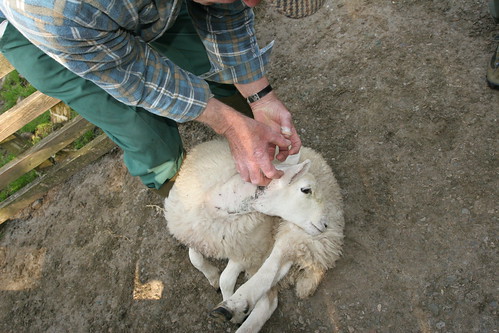
Anyhow, in June the mysterious killer struck. It's been killing sheep almost daily since. The lamb (born in April) pictured was found by the farmer last Tuesday. It has puncture wounds and tears around the neck. This one was lucky - it was found still alive, brought in and given penicillin, and now it's healing well. Many others have simply died or disappeared.
The vet thought the culprit might be an otter, or an eagle. The farmer has seen otter attacks before and doesn't think that's the explanation. He's sure it's an eagle. Probably not a sea eagle, he says, as he rarely sees those on his hill - although the crofters at Glendale are losing lambs to the sea eagle - but a golden eagle was seen in this area on the Monday, the day before this sheep was found. He cupped his hands into talons and held them over the lamb's neck. His fingers fitted the marks remarkably closely.
He's stoical about it, but he can't afford to lose lambs like this. At up to £70 per lamb, at this rate he'll be bankrupted.
He explained his philosophy about foxes to me: "I don't mind the foxes living on the hill," he said, "but every so often one turns killer. We shoot that one, and the killings stop."
I didn't ask whether he applied the same principle to eagles. I suspect I knew the answer already.
Real places, real people, scraping a real living doing real work and dealing with real problems. It's a million miles from the desk pilots with their romantic notions of how the countryside ought to work.
My spies on the ground in the Forest of Bowland tell me that there's another pair of eagle owls, besides the ones that appear to have come to a sticky end.
This other pair are older and more experienced, and have successfully fledged their chicks already - despite what's described as "swarms" of watchers crawling all over any raptor foolish enough to set up home in the area. I'm told the poor harriers have to put up with a hide barely 30 yards from their nest.
Meanwhile, back home, the foxes are coming in nicely to my bait. Here's one that grabbed a trout I'd left out. The foxes had been feeding all round it on and off through the night, but treating it with great suspicion. It wasn't until dawn began to break that this one plucked up courage to grab the fish...
I never thought I'd read that headline, never mind write it. But birdwatchers are, seriously, accusing the RSPB of killing birds of prey. Eagle owls to be precise. On the flimsy grounds that a) an eagle owl was videoed attacking a nesting harrier and b) said eagle owl appears to have met with an unfortunate accident.
Mark Avery is adopting the demeanour of a smacked puppy: "Just to stress," he implores, "there is no truth in the suggestion that the RSPB has been involved in the killing of these eagle owls."
Welcome to my world Mark. I've been a shooter all my life, and never persecuted a bird of prey. When some soppy urban bird-lover asked me to shoot the sparrowhawk killing 'her' blue tits, I told her to get lost.
And I'm sick of all the abuse thrown at 'the shooting industry' (myself included) for, apparently, killing wildlife wholesale out of sheer greed. I'm not an industry, I'm me. I grew up surrounded by wildlife. I love to watch it. Sometimes I like to catch some and eat it. Nothing could be more natural, unless you're one of those 'nature lovers' who hate humans.
Sure, there are some greedy people making a lot of money out of grouse moors, and some of those will be happy to kill harriers etc along the way. I'm not one of them. I despise them, and I wouldn't dignify them with the name 'shooter'.
They are developers, pure and simple. Like a property developer demolishing a bat roost, if wildlife gets in their way, they'll trample it.
I take no pleasure from seeing harriers harmed by owls. But I can't suppress a little smile as I watch the birders tie themselves in semantic knots about which bird of prey is more worthy than another, which one is more deserving of a place in Britain because it lived here before, and how man should intervene (or not) to correct an imbalance that man created (or not) etc, etc.
There's a real battle brewing between the 'leave nature alone and it'll all work out perfectly' brigade, and those who have some fluffy notion of a moment in prehistory when everything was just as it should be, and are forever trying to shoehorn nature into their picture of loveliness.
They're both wrong, and neither can succeed. Nature isn't (and never was) like that, and even if it was there's the little inconvenience of 60m or so humans sharing this small island, most of whom can't tell a house sparrow from a dunnock and are far more concerned with which footballer is going clubbing with whose wife this week, and what shoes she's wearing.
And yes, they'll happily sign a fluffy little letter to say how much they'd like to save the polar bears, but just try asking them to pay another tenner on the weekly shopping so their chicken nuggets can stretch their wings.
You can tell it's been a long week, can't you. Right-o, I'm off to have a weekend before I dissolve into a little steaming heap of cynicism. I might even go and sit in the woods and see if I can get some film of the fox cubs. That or fishing. Best therapy I know!
...no, not a gamekeeper, an eagle owl. Now there's a conundrum for the RSPB!
Mind you, that nice Mark Avery has still managed to make it sound like it's our fault:
Dr Mark Avery, the RSPB’s Director of Conservation, said: "Hen harrier numbers in England are perilously low due to years of illegal shooting and poisoning."
Any minute now, I expect Raptor Politics to claim it's all the fault of the local Wildlife Crime Officer, aided and abetted by the evil & bloodthirsty landowning toffs.
Still, at least the media are keeping a sense of proportion about urban foxes...